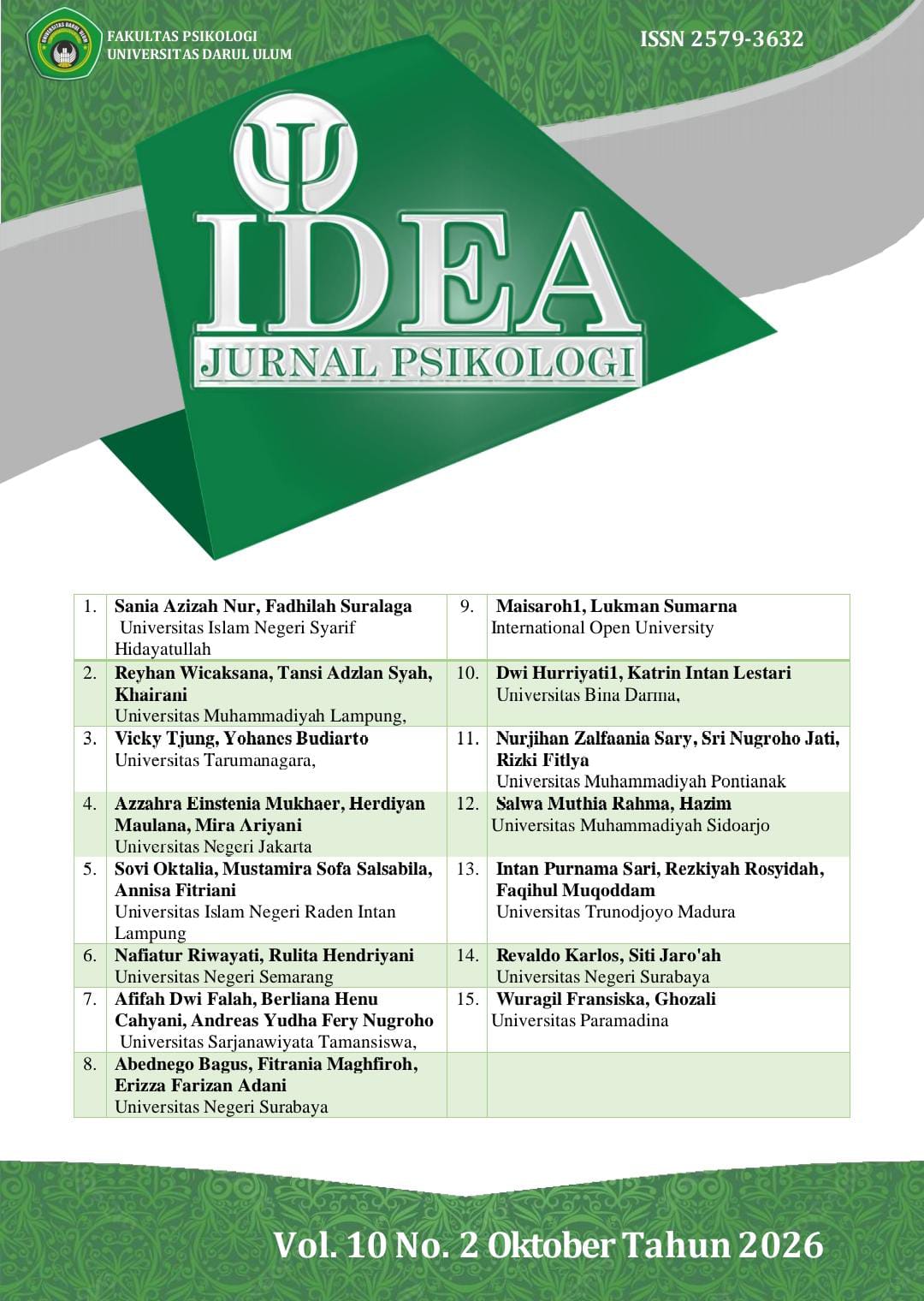
Peran Well-Being Terhadap Intensi Menikah Pada Perempuan Dewasa Awal yang Bekerja
DOI:
https://doi.org/10.32492/idea.v10i2.10204Keywords:
well-being, intensi menikah, dewasa awalAbstract
Well-being is a psychological factor that plays a role in the decision-making process during early adulthood, including in the formation of marital intention. This study aims to examine the effect of well-being on marital intention among working women in early adulthood. A total of 494 participants aged 19–30 took part in the study through purposive sampling and completed the Indonesian Well-being Scale (IWB) and the Intent to Marry Scale (IMS). Simple linear regression analysis showed that well-being had a significant effect on marital intention (p = 0.002) with an R² value of 0.020. These findings indicate that the level of psychological well-being is associated with the tendency of working women in early adulthood to form marital intentions. The results of this study provide insight into the role of internal factors in the decision-making process regarding marriage among working women in Indonesia.
References
Ajzen, I. (1991). The theory of planned behavior. Organisational Behavior and Human Decision Processes, 50(2), 179-211.
Himawan, K. K., Bambling, M., & Edirippulige, S. (2018). Singleness, Religiosity, and the Implications for Counseling: A Review of Indonesian Singles. Europe's Journal of Psychology, 14(2), 485-497.
Koçak, A., & Mouratidis, A. (2024). When Are You Going to Marry? Intention to Marry through the Lens of Theory of Planned Behavior and Self-Regulatory Focus. Turkish Journal of Counseling Psychology and Guidance, 14(72), 48-62
Love, J., Selker, R., Marsman, M., Jamil, T., Dropmann, D., Verhagen, J., … Wagenmakers, E.-J. (2019). JASP: Graphical statistical software for common statistical designs. Journal of Statistical Software, 88(2), 1–17. https://doi.org/10.18637/jss.v088.i02
Maulana, H., Obst, P., & Khawaja, N. (2018). Indonesian perspective of wellbeing: A qualitative study. Qualitative Report, 23(12), 3136-3152
Melero, S., Verdugo, L., & Sánchez-Sandoval, Y. (2023). oung Adult Adoptees’ Psychological Adjustment and Developmental Tasks: A 20-Year Follow-Up and Keys for Intervention. Frontiers in Psychology.
Mulyadi, B. (2018). Fenomena penurunan angka pernikahan dan perkembangan budaya omiai di Jepang. Kiryoku, 2(2), 65–71. http://ejournal.undip.ac.id/index.php/kiryoku
Navaitis, G., Labutis, G., & Kairienė, B. (2016). Marital status and happiness. Proceedings of the International Scientific Conference, 458-468.
Ndayambaje, E., Pierewan, A. C., Nizeyumukiza, E., Nkundimana, B., & Ayriza, Y. (2020). Marital Status and Subjective Well-Being: Does Education Level Take Into Account? Cakrawala Pendidikan, 39(1), 120-132.
Park, S. S., & Rosén, L. A. (2013). The Marital Scales: Measurement of intent, attitudes, and aspects regarding marital relationships. Journal of Divorce & Remarriage, 54(4), 295–312. https://doi.org/10.1080/10502556.2013.780491
Raymo, J., Park, H., Xie, Y., & Yeung, W. (2015). Marriage and Family in East Asia: Continuity and Change. Annu Rev Sociol, 471-492.
Repi, A. A., & Maliombo, N. E. (2022). Karir atau Hubungan, Manakah Pilihanku? Pengambilan Keputusan Menikah Pada Wanita Karir. Psychopreneur Journa, 6(2), 60-75.
Stutzer, A., & Frey, B. S. (2006). Does marriage make people happy, or do happy people get married? The Journal of Socio-Economics, 35(2), 326–347. https://doi.org/10.1016/j.socec.2005.11.043
Sugiyono. (2019). Metode penelitian kuantitatif, kualitatif, dan R&D. Bandung, Indonesia: Alfabeta.
Utomo, A., & Sutopo, O. R. (2020). Pemuda, Perkawinan, dan Perubahan Sosial di Indonesia. Jurnal Studi Pemuda, 77-87.
Wadsworth, T. (2016). Marriage and Subjective Well-Being. Social Indicators Research, 1025-1048 .
Downloads
Published
How to Cite
Issue
Section
License
Copyright (c) 2026 Azzahra Einstenia Mukhaer, Herdiyan Maulana, Mira Ariyani

This work is licensed under a Creative Commons Attribution 4.0 International License.