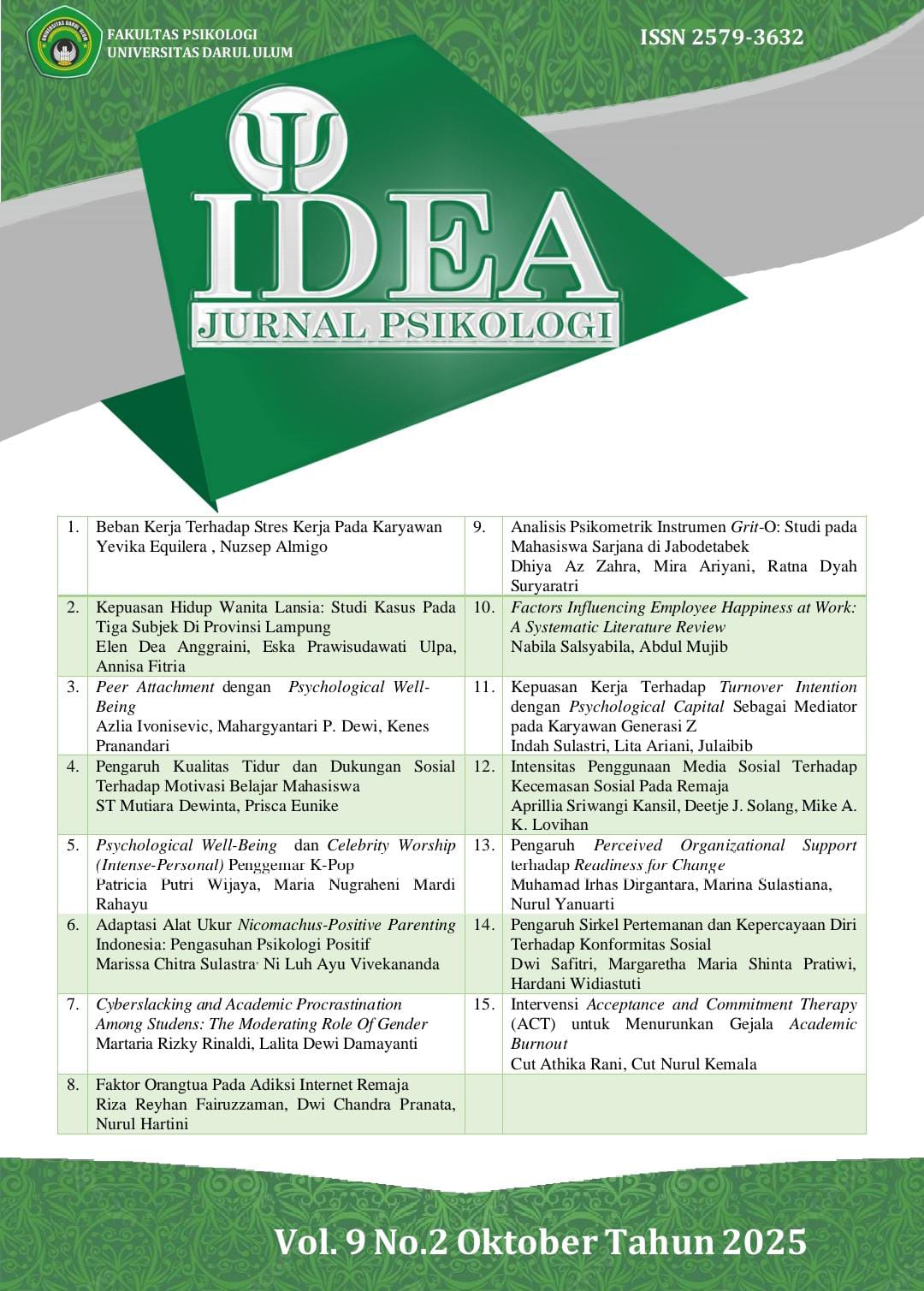
Adaptasi Alat Ukur Nicomachus-Positive Parenting Indonesia: Pengasuhan Psikologi Positif
DOI:
https://doi.org/10.32492/idea.v9i2.9206Keywords:
Pengasuhan Psikologi Positif, Nicomachus-Positive Parenting (NPP), Adaptasi Skala, Validitas, ReliabilitasAbstract
Parenting is a significant topic in developmental psychology, widely discussed among both scholars and the general public. Positive psychology-based parenting is a promising area of study, as it can support both parents and children in achieving well-being in their lives. This study aims to adapt the Nicomachus-Positive Parenting (NPP) scale into the Indonesian language. The NPP is a measurement tool developed by Thodoros A. Kyariazos and Anastassios Stalikas in 2019. It is grounded in the principles of positive psychology and consists of four factors: nurturing values, strength identification & boosting, parenting context, and involvement. This study involved 203 parents with children aged 7–13 years. The results of the Confirmatory Factor Analysis (CFA) indicate that the 16-item scale demonstrated a good model fit (X²/df = 1.588; RMSEA = 0.054; RMR = 0.040; GFI = 0.916; CFI = 0.931; TLI = 0.911; AGFI = 0.876; IFI = 0.933). Cronbach's Alpha calculation further confirmed the reliability of the instrument (α = .817, p ≤ .001). Therefore, the findings suggest that the Indonesian version of the Positive Psychology Parenting scale is a valid and reliable measurement tool.
References
Alex Linley, P. J. (2006). Positive Psychology: Past, Present, and (Possible) Future. The Journal of Positive Psychology, 3-16.
Commision, T.-I. T. (2017). ITC Guidelines for Translating and Adapting Tests. International Journal of Testing, 101-134.
Darling, N. &. (1993). Parenting Style as Context: An Integrative model. Psychological Bulletin, 487-496.
Darmagita, S. F. (2022). Adaptasi Alat Ukur Parental Authority Questionnaire Revised (PAQ-R) untuk Orang Tua Dengan Anak Usia 2-18 Tahun. Psikostudia: Jurnal Psikologi, 561-574.
Duncan, L. G. (2009). A Model of Mindful Parenting: Implication for Parent-Child Relationships and Prevention Research. Clinical Child and Family Psychology Review, 255-270.
Fahiroh, S. A. (2019). Validation of Parenting Styles and Dimensions Questionnaire (PSDQ) on Adolescents. Journal of Educational, Health, and Community Psychology, 177-195.
Fredrickson, B. (2009). Positivity: Groundbreaking Research Reveals How to Embrace the Hidden Strength of Positive Emotions, Overcome Negativity, and Thrive. New York: Crown.
Gable, S. L. (2005). What (and Why) is Positive Psychology? . Review of General Psychology, 103-110.
Hair, J. F., Black, W. C., Babin, B. J., & Anderson, R. E. (2010). Multivariate data analysis: A global perspective (seventh ed). New Jersey: Pearson Education, Inc
Hardani, R. S. (2022). Strength-Based Parenting Scale Adaptation and Validation for Adolescents in Eastern Culture: Strength-Based Parenting Scale Adaptation. IIUM Journal of Human Sciences, 15-25.
Hasyyati, B. M. (2022). Parenting-Related Self-Compassion Scale (P-SCS): Adaptation and Validation Indonesian Parents. The Open Psychology Journal.
Ilma Antawati, D. &. (2023). Indonesian Translation and Validation of Co-Parenting Relationshp Scale Brief Version (Brief-CRS). Qubahan Academic Journal, 342-351.
Jefferson, F. A. (2020). Parenting Self-Compassion: A Systematic Review and Meta-Analysis. Mindfulness, 2067-2088.
Kyriazos, T. A. (2018). Positive Parenting or Positive Psychology Parenting? Towards a Conceptual Framework of Positive Psychology Parenting. 1761-1788.
Kyriazos, T. A. (2019). Nicochamus-Positive Parenting (NPP): Development and Initial Validation of Parenting Questionnaire within the Positive Psychology Framework. Psychology, 2115-2165.
Lerner, R. M. (2002). Developmental Systems Perspective on Parenting. In M. H. Bornstein (Ed.), Handbook of Parenting: Biology and Ecology of Parenting. New Jersey: Lawrence Erlbaum Associates Publishers.
Parfitt, Y. &. (2014). Transition to Parenthood and Mental Health in First-time Parents. Infant Mental Health Journal, 263-273.
Prihandini, G. R. (2019). Pengembangan Alat Ukur MIndful Parenting untuk Orang Tua dari Remaja di Indonesia. Jurnal Psikogenesis, 215-227.
Rubiyanti, Y. J. (2023). Indonesian Scale F-PoPa and M-PoPa: Adolescent Perception of Positive Father and Mother Parenting in Indonesia. Journal of Hunan University Natural Sciences.
Sanders, M. R. (2012). Development, Evaluation, and Multinational Dissemination of the Triple P-Positive Parenting Program. Annual Review of Clinical Psychology, 345-379.
Santrock, J. W. (2015). Life-span Development (15th Ed.). New York: McGraw-Hill.
Sari, I. P. (2013). Ketakbiasaan Dalam Model CFA (Confirmatory Factor Analysis) Pada Metode Estimasi DWLS (Diagonally Weighted Least Squares) Untuk Data Ordinal. Prosiding SEMIRATA.
Seligman, M. E. (2002). Authenthic Happiness: using the New Psychology to Realize Your Potential for Lasting Fulfillment. New York: Free Press.
Seligman, M. E. (2015). Positive Psychology: An Introduction. American Psychologist, 5-14.
Sheldon, K. M. (2001). Why Positive Psychology is Necessary. American Psychologist, 216-217.
Stratton, S. J. (2021). Population Research: Convenience Samping Strategies. Prehospital and Disaster Medicine, 373-374.
Usha Nandhini, R. &. (2021). Assessment of Positive Parenting Style and Dimensions Among Parents of Primary Children Using Nicochamus-Positive Parenting (NPP) Questionnaire. Multicultural Education.
Waters., L. (2017). The Strength Switch: How The New Science of Strength-Based Parenting Can Help Your Child and Your Teen to Flourish. Penguin.
Downloads
Published
How to Cite
Issue
Section
License
Copyright (c) 2025 Marissa Chitra Sulastra, Ni Luh Ayu Vivekananda

This work is licensed under a Creative Commons Attribution 4.0 International License.