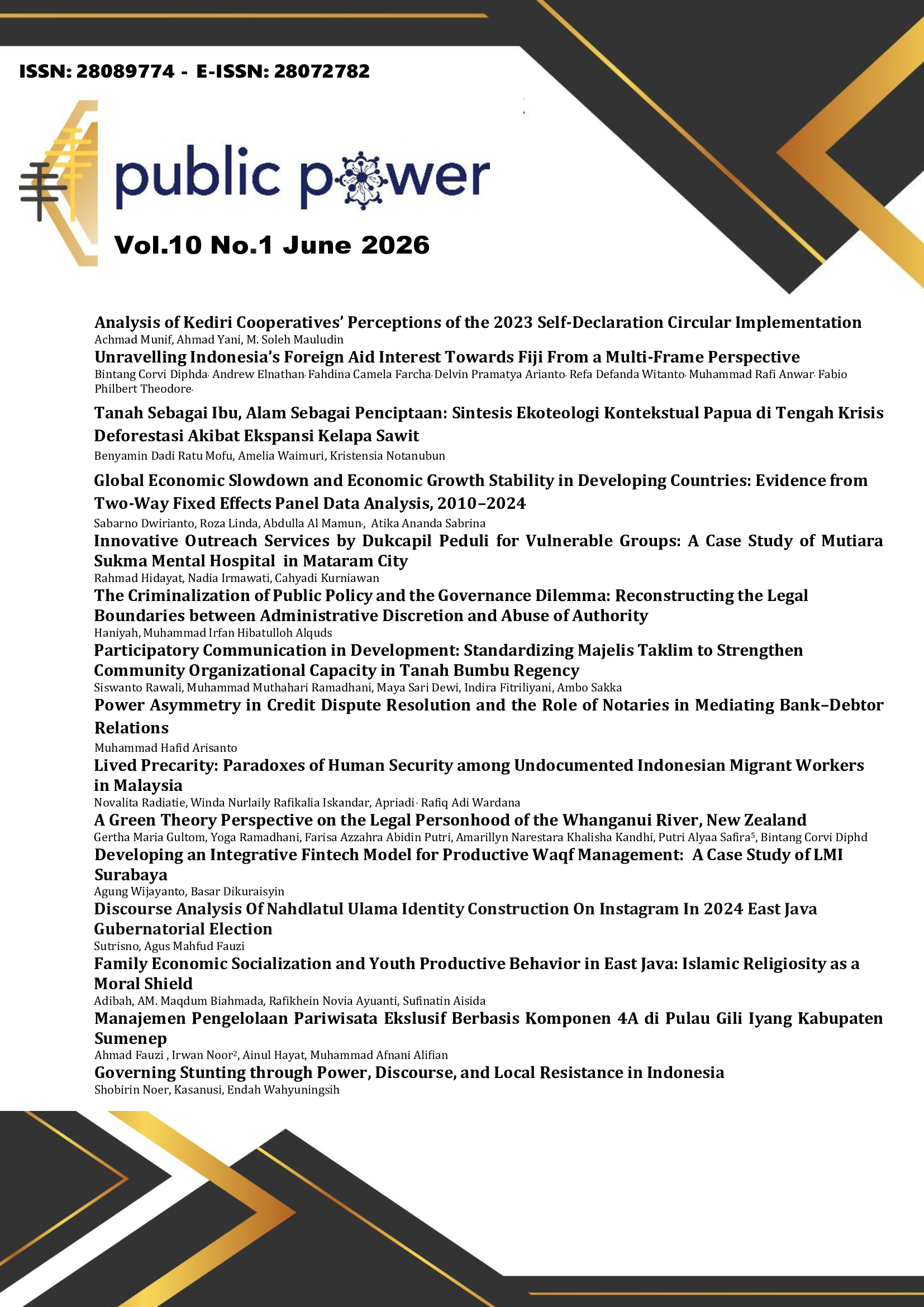
Family Economic Socialization and Youth Productive Behavior in East Java: Islamic Religiosity as a Moral Shield
DOI:
https://doi.org/10.32492/JPP.V10i1.10113Keywords:
Digital Natives, Family Economic Socialization, Islamic Religiosity, Moral Shield, Productive BehaviorAbstract
In an era of economic volatility and pervasive digitalization, the younger generation confronts the intensifying pressures of consumerism culture driven by the fear of missing out (FOMO), which threatens productive work ethics and exacerbates youth unemployment. This study analyzes the direct and indirect effects of family economic socialization on youth productive behavior, positioning Islamic religiosity as a mediating variable. Employing a causal quantitative design, this study examined 385 Muslim youths in East Java classified as digital natives. Data collected through structured questionnaires were analyzed using Partial Least Squares Structural Equation Modeling (PLS-SEM) via SmartPLS 4. Results reveal that family economic socialization positively and significantly influences Islamic religiosity (β = 0.754, p = 0.000) and youth productive behavior (β = 0.465, p = 0.000). Islamic religiosity further exerts a positive and significant influence on productive behavior (β = 0.249, p = 0.000), while the indirect effect confirms its critical mediating role (β = 0.188, p = 0.000). The study extends Social Cognitive Theory by incorporating Islamic religiosity as an internal self-regulatory mechanism that mediates family-based economic learning and productive behavior.
References
Amagir, A., Groot, W., Maassen van den Brink, H., & Wilschut, A. (2020). Financial literacy of high school students in the Netherlands: Knowledge, attitudes, and financial behavior. International Journal of Consumer Studies, 44(4), 362–373. https://doi.org/10.1111/ijcs.12571
Amalia, E. (2022). Ekonomi Islam dan pembentukan perilaku produktif: Kajian nilai-nilai religiusitas sebagai filter moral. Jurnal Ekonomi Islam, 13(1), 45–61.
Anwar, S., Wardoyo, C., & Rachmawati, L. (2024). Analisis ketahanan ekonomi generasi muda: Menakar efektivitas financial socialization agen primer di era volatilitas digital. Jurnal Pendidikan Ekonomi (JUPE), 12(1), 15–28.
Badan Pusat Statistik. (2025). Statistik pemuda Indonesia 2024. Badan Pusat Statistik.
Dinas Koperasi dan UKM Jatim. (2025). Laporan tahunan perkembangan UMKM kreatif pemuda Jawa Timur 2024. Dinas Koperasi dan UKM Provinsi Jawa Timur.
El-Menabawey, A., et al. (2023). Islamic religiosity as an internal value system: Beyond utility maximization toward maslahah orientation in consumption behavior. Journal of Islamic Business and Economic Review, 6(2), 114–129.
Fitria, N., & Arifin, Z. (2021). Internal value system dan etos kerja produktif: Menguji peran religiositas Islam pada pelaku usaha muda. Jurnal Psikologi Islam, 8(2), 145–158.
Gudmunson, C. G., & Danes, S. M. (2011). Family financial socialization: Theory and critical review. Journal of Family and Economic Issues, 32(4), 644–667. https://doi.org/10.1007/s10834-011-9275-y
Hair, J. F., Hult, G. T. M., Ringle, C. M., & Sarstedt, M. (2021). A primer on partial least squares structural equation modeling (PLS-SEM) (3rd ed.). Sage Publications.
Handoko, R., Purwanto, A., & Utomo, S. (2022). Menumbuhkan entrepreneurial intention berbasis nilai altruistik: Studi empiris perilaku produktif komunitas pemuda di Jawa Timur. Jurnal Pendidikan Ekonomi & Bisnis, 10(2), 134–148.
Hasanah, U., & Wahyudi, A. (2024). Internalization of Islamic financial values in early childhood environment: A case study of Muslim families in East Java. Journal of Islamic Economics and Finance, 10(1), 45–62.
Hassan, M. K., Aliyu, S., & Mohamad, S. (2022). Islamic religiosity, financial knowledge, and materialist values in shaping Muslim youth economic behavior. Journal of Islamic Marketing, 13(4), 812–831. https://doi.org/10.1108/JIMA-04-2020-0112
Henseler, J., Ringle, C. M., & Sarstedt, M. (2015). A new criterion for assessing discriminant validity in variance-based structural equation modeling. Journal of the Academy of Marketing Science, 43(1), 115–135. https://doi.org/10.1007/s11747-014-0403-8
Kurniawan, A., & Setiawan, M. (2024). Future orientation and digital human capital investment: Driving productive financial behavior among Gen Z. International Journal of Consumer Studies, 48(2), 215–231. https://doi.org/10.1111/ijcs.13012
Lusardi, A., & Mitchell, O. S. (2014). The economic importance of financial literacy: Theory and evidence. Journal of Economic Literature, 52(1), 5–44. https://doi.org/10.1257/jel.52.1.5
Mahdzan, N. S., Zainudin, R., Sukor, M. E. A., Zainir, F., & Ahmad, I. H. (2019). Determinants of financial well-being among Malaysian households: The mediating role of financial literacy and Islamic religiosity. Journal of Islamic Marketing, 11(5), 1101–1123. https://doi.org/10.1108/JIMA-10-2018-0196
Masyhuri, A., & Wardoyo, C. (2024). Menakar peran religiositas sebagai moral anchor terhadap perilaku produktif digital natives di Jawa Timur. Jurnal Ilmiah Ekonomi Islam, 10(1), 188–201.
Mokhlis, S. (2009). Relevancy of religiosity in consumer behavior research: A prescription for Islamic marketing. International Business Research, 2(2), 75–83.
Mubaidullah, A. (2022). Religiositas sebagai variabel mediasi dalam model perilaku ekonomi Islam: Kajian literatur dan agenda riset. Jurnal Ilmiah Ekonomi Islam, 8(3), 301–315.
Nafiah, L. (2023). Peran pesantren dalam pembentukan karakter ekonomi santri di Jawa Timur. Jurnal Pendidikan Islam, 12(1), 78–94.
Otto, A. M. (2013). Saving in childhood and adolescence: Insights into the development of consumer behavior. Economics of Education Review, 34, 281–291.
Parrotta, J. L., & Johnson, P. J. (2019). The impact of financial socialization on financial management behavior and financial well-being of young adults. Family and Consumer Sciences Research Journal, 47(4), 324–340.
Putri, E. R., & Rahma, S. (2021). Analisis determinan kemandirian finansial dan kesiapan kerja pada generasi muda. Jurnal Ilmiah Akuntansi dan Finansial Indonesia, 5(2), 89–104.
Rahmat, T., Setiawan, B., & Handoko, R. (2025). Transforming Homo Economicus into Homo Islamicus: The role of family socialization and financial self-efficacy among Muslim undergraduate students. International Journal of Islamic and Middle Eastern Finance and Management, 18(2), 210–229. https://doi.org/10.1108/IMEFM-03-2024-0095
Retnawati, L., Setiawan, B., & Utomo, S. (2021). Pengaruh sosialisasi ekonomi keluarga terhadap literasi keuangan dan perilaku konsumtif remaja. Jurnal Pendidikan Ekonomi & Bisnis, 9(2), 118–130.
Richins, M. L. (2017). Materialism pathways: The processes that create and perpetuate materialism. Journal of Consumer Psychology, 27(4), 480–499. https://doi.org/10.1016/j.jcps.2017.07.006
Rizkiana, I. A., & Handayani, S. (2022). Pengaruh sosialisasi keuangan keluarga dan literasi keuangan terhadap perilaku manajemen keuangan dengan efikasi diri sebagai variabel mediasi. Jurnal Ilmiah Akuntansi dan Finansial Indonesia, 6(1), 45–58.
Saraswati, D., & Utama, I. B. (2025). Nurturing economic resilience: The impact of primary socialization on youth's productive and innovative financial behaviors. Journal of Islamic Monetary Economics and Finance, 11(1), 78–96. https://doi.org/10.21098/jimf.v11i1.1712
Shim, S., Barber, B. L., Card, N. A., Xiao, J. J., & Serido, J. (2010). Financial socialization of first-year college students: The roles of parents, work, and education. Journal of Youth and Adolescence, 39(12), 1457–1470. https://doi.org/10.1007/s10964-009-9432-x
Sina, P. G. (2020). Peran orang tua dalam mendidik keuangan anak (kajian teori sosialisasi finansial). Jurnal Pendidikan Akuntansi, 8(2), 195–208.
Sina, P. G. (2021). Pola asuh keuangan orang tua (parenting financial) bagi generasi Z. Jurnal Pendidikan Akuntansi (JPAK), 9(1), 112–125.
Suhendra, I., & Heriany, O. (2023). Islamic religiosity as a psychological capital for fostering productive and entrepreneurial behavior among young generation. Journal of Islamic Economics and Business, 9(1), 34–49.
Suryanto, T. (2023). Generasi Z, budaya populer digital, dan tantangan perilaku ekonomi syariah di Indonesia. Jurnal Ilmiah Ekonomi Islam, 9(1), 77–89.
Utami, T. W., & Rahmawati, A. (2023). Beyond materialism: The role of religious family financial socialization in shaping ethical consumption among Muslim youths. Journal of Islamic Monetary Economics and Finance, 9(3), 401–418. https://doi.org/10.21098/jimf.v9i3.1672
Wahyudi, R., & Setiawan, M. (2025). Religiositas sebagai jangkar moral dalam menghadapi perilaku konsumtif berbasis FOMO pada mahasiswa Muslim. Jurnal Psikologi Islam, 12(1), 34–48.
Wardoyo, C., Anwar, S., & Rachmawati, L. (2023). Career adaptability and financial self-efficacy: Explaining the pathway to digital entrepreneurship among Indonesian vocational students. Journal of Education and Learning (EduLearn), 17(3), 412–424. https://doi.org/10.11591/edulearn.v17i3.20651
Wildana, W. (2021). Karakteristik religiusitas masyarakat Jawa Timur: Antara tradisi pesantren dan dinamika modernitas. Jurnal Sosial Budaya, 18(2), 134–149.
Downloads
Published
How to Cite
Issue
Section
License
Copyright (c) 2026 Adibah, AM. Maqdum Biahmada, Rafikhein Novia Ayuanti, Sufinatin Aisida

This work is licensed under a Creative Commons Attribution-NonCommercial 4.0 International License.